
Following the Script
My seminary experience and the ways it echoes through life


Boston University School of Theology
I don’t often say happy things about my seminary. I enrolled at Boston University School of Theology (BUSTh) in 2008 with the understanding that I was a liberal, and I was going to be attending an exemplary school to be equipped with the best minds of our day and the best practices in caring for the poor. All of the recruitment material and conversations led me to believe that I was going to be spending the next three years at perhaps the finest institution for combining liberal orthodoxy and orthopraxis (doing the right things). It was my explicit game plan to enter the clergy of The United Methodist Church to utilize the authority given me to mobilize people to care for the poor. It turned out they did NOT have the programs in place, nor the inroads with the poor and the various ministries that engage poverty, that I was ensured.
In fact, they didn’t even have relationships built with all of the area churches in my denomination. When I eventually sought out a relationship with a church only a few miles away, I was the only seminarian in attendance, and it took a good deal of work for me to establish the relationship. I was told that my school was “the school of the prophets.” They made that sound like we were on the front lines of care for the poor and downtrodden. What it really meant was that we talked about MLK (who also attended BUSTh) a bit while bullying everyone into the right woke positions in vogue at that time. Lots of the students got a lot of pleasure from being on the right side of history. I was pretty grossed out. The virtue signaling and moral grandstanding I saw on the daily basis, coupled with the loneliness and anonymity of living in a large cosmopolitan American city, led to great regret that I had ever gone to seminary in Boston.
Then I read the Bible and the Holy Spirit moved again in my life. I was changed, the scales fell off my eyes, and I was converted. My time at BUSTh was a generally unpleasant time, punctuated with experiences that taught me a lot.
While I did learn some in my classes, the most profound experiences were the interpersonal exchanges in that program. It was in these exchanges that the teachings of the institution metabolized. When an ideology claims to advocate an approach that is of benefit to global minority populations, but those populations enrolled at the school are marginalized, that reality speaks louder than any marketing rhetoric they might promote. When they facilitate an Anna Howard Shaw Center for women’s empowerment, but group times are insufferable struggle sessions with miserable women, that speaks loudly. When the institution’s ideas of caring for the poor look more like protesting than actually getting to know homeless people…
The dissonance of those years is something I will never fully get over. People who in the name of love are so snobby and hateful. People who in the name of Jesus spend thousands of dollars to come together and learn how to disregard his Word…
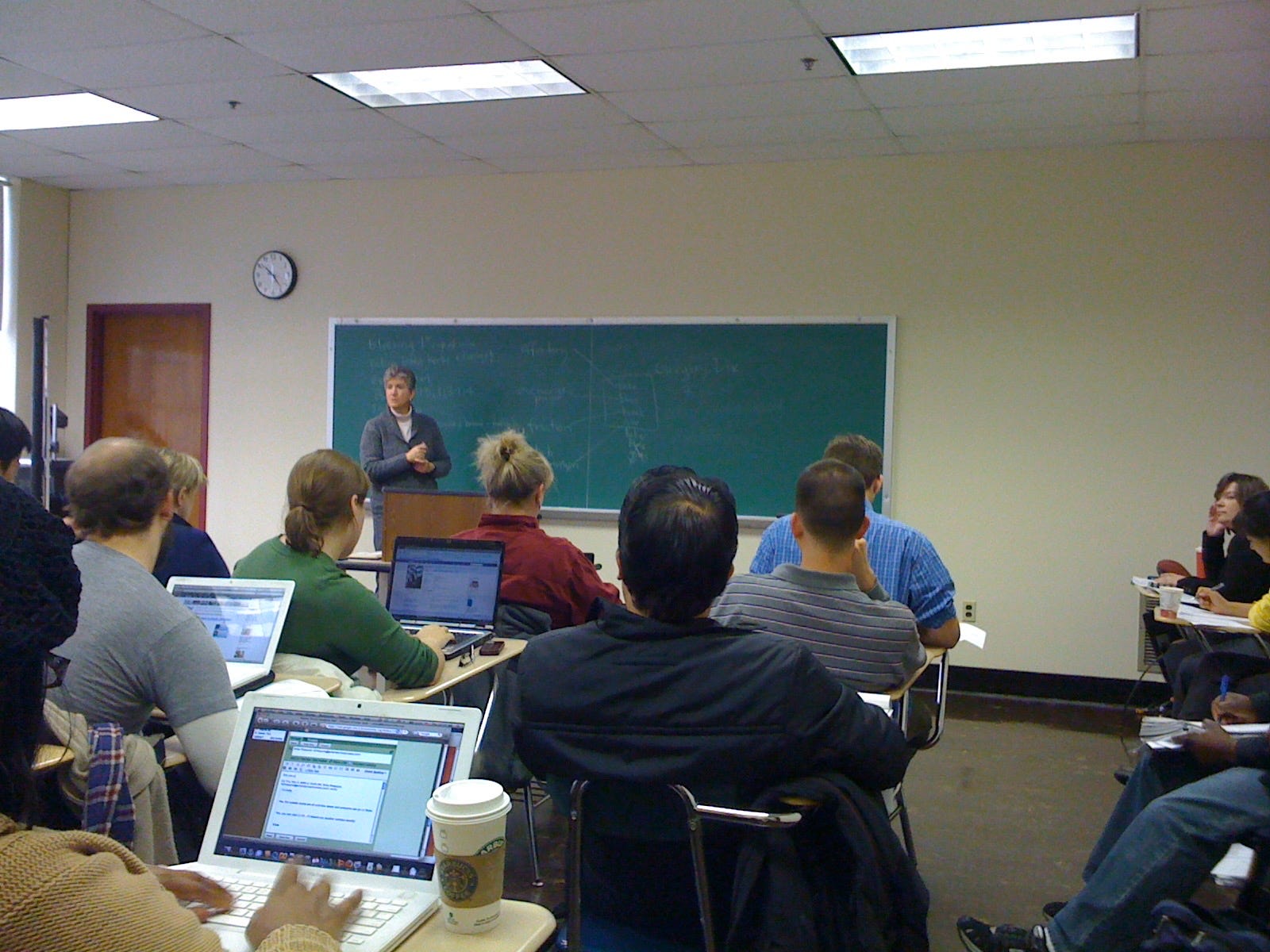
I learned a lot in those years. I did not keep my head down, but was instead as active as I could manage in the student body. I eventually involved myself in starting the John Wesley Club, which is still going, last I checked. I also participated in a ‘Religion and Science’ club, which basically met to talk about the topic of how science and religion relate, even inviting guests a time or two to speak about the intersection of these two disciplines. Our faculty sponsor was a very intelligent Australian named Dr. Wesley Wildman.
An Exemplary Professor
Wildman was not only intelligent, but also charismatic and charming. He was the sort of professor that somewhat naturally builds up something of a fan base. I never got the sense that he asked for it, but the academy is weird. Students look for professors not only to learn from, but to model themselves off of. I wouldn’t be surprised if I subconsciously took a rhetorical tactic, posture, or affect from Wildman. He was persuasive and erudite, never (to my mind) unnecessarily wordy. There didn’t seem to be much ego in his presentation. I saw him often bend over backwards to accommodate weaker members of the student body. He was also unflinching in his criticism/critique of those students whom he thought could handle it.
Don’t let my admiration give the impression that Dr. Wildman was at all impressed with me, or appreciative of my presence. He tolerated me politely enough, but he generally seemed to receive me as somewhat of an annoyance that he would tolerate out of his largesse. And he did so with grace.
Wildman was almost certainly a man of the left, but more than that, he was a man seeking truth. I would associate him with a Peter Boghossian type of man, definitely not of the right, but also not willing to toe the party line. I think of him as an exemplar of an increasingly rare species: a man with the conviction that the truth supports social progress. Today’s progressives are so insecure about their convictions as to receive questions at personal attacks, and increasingly to respond with violence and anger. Not so with Wildman. A challenge was received, and responded to, as an invitation to seek a friendly truth, and to grow in wisdom.
I got to see him in top form, not in the middle of any course he taught, but in a small group setting of the Science and Religion Club. As I recall, there were only five or six of us in attendance that evening. Dr. Wildman facilitated a discussion on evolution versus intelligent design. As the topic was broadly presented up front, I remember a couple of students, one in particular, looked around the group and snickered, as though it would be so easy to wipe the floor with the troglodyte intelligent design arguments. Wildman gave the floor to this student and a couple of others to articulate the case for evolution and natural selection. The students rehearsed confidently the popular refutations of intelligent design, smugly reinforcing the notion that learned Christian leadership was right to abandon any notion that God had actively facilitated the development of any creature to bear his image. Heads nodded as students proclaimed the cultural outcome of the Scopes Monkey Trial as the only acceptable orthodoxy of a liberal Methodist institution. Nothing was said that surprised me, or would surprise you, I’m sure.
But then something truly surprising did happen: Dr. Wildman spoke up and gently dismantled each point made. He articulated the problems with evolution, the god it reflects, and the conclusions it brings regarding the purpose of life and what we are all doing here. With gentleness, and in very short order, he left those articulating the theory feeling quite small. It was an amazing thing to behold. As I recall, it was one of the few group situations in which I felt no need to pipe in. It was rapturous simply to be a fly on the wall and watch the faces of these elite students deal with the fabric of BUSTh being torn right in front of them: Dr. Wildman had left the script.
Why Christian Institutions Fall Away from Christian Convictions
See, most higher educational institutions for clergy do not necessarily teach their students how to think. Rather, they are indoctrination centers. BUSTh was clear that their intention was to tear down the theology of incoming students and then equip students to build something back in its place. The problem is that postmodern thought really doesn’t allow for the reconstruction of much of anything. The result is that students are very easily able to problematize and deconstruct things, but not so able to create anything sustainable on the other side. Group interactions become an exercise in tearing down what has traditionally been taught, then collectively concluding not to talk about the fatal flaws in liberal thought. It is stultifying. Those rare students who have the temerity to actually take up counterpoints in those conversations are roundly criticized. That was me. I tore the social fabric of that place several times and was therefore disliked by many. But it was one thing for a student to do it; it was a violation of another order for a professor to do it.
Dr. Wildman, as I recall, made clear in his presentation of intelligent design, that he actually did not personally subscribe to it. I’m not sure if he subscribes to evolution or some variation of it. That actually doesn’t matter to me, as the role of the professor isn’t to indoctrinate. It really is to teach students how to critically engage with the material, such that they graduate with an ability to generate something greater than a party line.
Yet that sort of academic leadership is quite rare. In our time of polarization, there are few incentives in place to facilitate critical free thought. Truly free thinking comes with much discomfort and great threat. If one abandons loyalties and dogmatic constraints and allows for other views to be presented in their most robust forms, then one is flirting with the potential conflagration of many ideas. Free thought requires that one steel-man the arguments of those on all sides, puts them in dialogue with one another, then adopts the framework that best explains what reality is. Such a process hopefully ends with a reinforcement of one’s moral convictions, but often it doesn’t. This then requires that the individual revise themselves on a moral level. That is the process I went through, resulting in something approximating a Christian fundamentalist. I believe an unflinching pursuit of truth leads to Christ, partly because that is what I have personally experienced in my own life.
College broadly, and seminary specifically, is a financial enterprise. Those institutions that thrive and flourish are those who equip their students, not necessarily to engage critically with the world, but to participate sufficiently in worldly structures as they have been designed. Clergy indoctrinated in liberal seminaries were able to effectively take over my former denomination because the seminaries became the chokepoint for anyone wanting to be clergy. If one wanted to get good appointments and climb the ladder of churches to the high-paying, top-salaried ones, then they did well to get a degree from one of the official seminaries, with friendships and recommendations from the professors there. The actual ability to think, preach, or do ministry is not nearly so important as the ability to complete the paperwork and jump through the hoops.
Yet the problems in higher education are not contained only within liberal colleges and seminaries. Many extant colleges today were founded explicitly to be evangelical, standing somewhat against liberalism. In the last year, many of these institutions have drawn attention because they have not been able to hold the line against worldly influence. I have covered developments pertaining to Wheaton, Fuller, and Baylor that are concerning. Recently, Alisa Childers has been talking about Biola. It does not seem that these institutions are nearly as concerned about theological drift as they should be. Stories often leak of students and professors saying and doing things that shouldn’t be tolerated at any Christian institution, much less an evangelical one. What is going on?
You might consider my conversation with Everett Piper, former President of Oklahoma Wesleyan University, on this topic. He has a lot of specific advice to give about how Christians can and should examine our institutions. I find him compelling:
Creeping Sensitivities & Giving Ground in the Culture War
These evangelical institutions still need to pay the bills. They need students who can be equipped to navigate credentialing processes. They need professors that don’t push the students to think about uncomfortable things.
It has been substantiated pretty convincingly by many, perhaps most famously by Jonathan Haidt and Greg Lukianoff, in The Coddling of the American Mind that Americans have grown much more fragile in recent years. Not just young people, but all generations have grown increasingly sensitive to discomfort. Institutions receive constant pressure from all directions to conform to a set of expectations that cater to fragile people. That means fostering a pattern of behavior that results in very few things being said that aren’t a part of the script, at least by professors. Professors that destabilize that ‘safe space’ of an institution, among the students or faculty, are regularly shown the door and alienated. The number of institutions willing to hire such free thinkers are small and shrinking. It is better to have mediocre faculty that toe the line rather than extraordinary minds that have little regard for modern pieties. There are fewer headaches and risks if an institution can learn to just play nice with the world.
Joe Rigney’s work describing ‘The Anatomy of a Steer’ does a lot to flesh out the dynamics of how so many institutions fail to hold the line. The pattern is commonly substantiated, with few institutions managing an effective defense. As in the case of churches, all institutions are, from time to time, put in the position of choosing money or integrity. Very few in leadership are able to identify the voice of the evil one in that contest: “Okay, I can compromise on this issue. I will bide by time and then be ready for when it really matters.” “This isn’t a hill worth dying on; live to fight another day.” It is death by a thousand cuts. By the time the real battles come, the troops are so demoralized that they cannot stand together. Many seem unable to comprehend that there is even a war going on. They identify as peacetime civilians. They have lived on earth in luxury and self-indulgence, being fattened for the day of slaughter. They are more prone to turn on fellow Christians who are doing the battle in earnest than on those who are seeking to re-paganize our society. A great litmus test for figuring out who these folks are is to see who is offended by the start of my paragraph referencing Joe Rigney.
Those Christians who bristle at Doug Wilson and Charlie Kirk, those who are embarrassed of scriptural inerrantists and fundamentalists, those who laud David French and Russell Moore as they willfully engage in friendly fire—these are the very people who are going to be unable and unwilling to take hard stands against a depraved generation. They will laud themselves for not being as liberal as the most progressive extremes, while simultaneously decrying folks like Megan Basham and JD Hall for contending vociferously against those progressive extremes. I believe we are right now seeing that the way we have been comfortable having religious public discourse in our nation has been insufficient for the task at hand. As Sid Johnson the Earnest Wesleyan said: “We can not go back to how things were before, or we will have more days like yesterday. Punching right and speaking softly to the left is not acceptable, it enables evil.”
Many of the folks reading my articles won’t know these cultural markers, these personalities I have referenced. They are just trying to be faithful Christians in local churches. They want to play nice with the systems currently established, trusting that they can send their youth to be inculcated and made effective ambassadors of Christ. What I’m trying to communicate is that such trust should never have been given. Christ has established us as ambassadors, as holy fruit inspectors. We have nothing more important to do than to ensure that those who operate in the name of Jesus are being faithful in their endeavors. It is entirely appropriate and germane, even laudable, for Christians to require such quality from our institutions. If you are wanting to go home and turn on the tv, trusting that everyone is basically doing alright, then you are part of the problem.
A charge to keep I have, a God to glorify,
a never-dying soul to save, and fit it for the sky.In youth and hoary age, my calling to fulfill:
O may it all my powers engage to do my Master’s will!Teach me to watch and pray, and on Thyself rely,
assured if I my trust betray, I shall forever die…
We have been entrusted with a few things. We must be faithful.
What is at stake?
Another profound memory I have from seminary was a conversation I had midweek with one of my professors. He had called me to his office because I was somewhat regularly pushing back in various capacities in class, and I think he was finding me tiresome. “What is at stake for you?” he asked. It was slightly confrontational, but more curious. He could tell from my demeanor that I was genuinely anxious about the moral import of what we were discussing. I stammered briefly at the strangeness of the question. Seminary deals with the most meaningful things in life. Salvation is at stake. These things have ultimate import. When I eventually articulated these ideas to my professor, he seemed not to hear me. It was very strange. I continue to frequently get that sort of indifference from others in authority, with a hint of defensiveness, as I warn about the wiles of the devil.
Christians need to understand that the evil one is constantly contending on every battle ground to gain whatever ground can be gained. If we do not stand firm, stay vigilant, maintain a healthy skepticism, then we are sure to be overtaken. The next chapter of American public religion could be another of decline and compromise, or it could be a shoring up and a galvanizing of what is left.
“No discipline seems pleasant at the time, but painful. Later on, however, it produces a harvest of righteousness and peace for those who have been trained by it. Therefore, strengthen your feeble arms and weak knees. “Make level paths for your feet,” so that the lame may not be disabled, but rather healed.
- Hebrews 12:11-13
Humans naturally want to relax and trust that everything is going to work out. I think we need to better understand that, yes, God is Sovereign and nothing an threaten his plans. Even so, we need to choose whether or not we want to be a part of those plans. If we are not willing to put in the effort to guard that which he has entrusted to us, then why do we imagine that God will be pleased to maintain his presence among us?
I’m thankful all the time for that experience of seeing Dr. Wildman leave the script, remove the feeling of safety from the students, and make us use our brains critically for once. I have had the joy and discomfort many times of seeing the veil removed. This was just one of perhaps a dozen incidents at BUSTh in which I got to see how lacking the liberal theological tradition is. But since then I have also gotten to see the hostility of an anemic and insecure milquetoast conservatism, yearning for days of peace, unable to comprehend spiritual warfare. Conservatives who think warfare is about praying for a ‘hedge of protection’ but not speaking against abortion or divorce, who think the solution to our woes is to practice healing prayer in worship services more but not practice truth-telling on the doctrine of original sin and total depravity. We might all say we are ‘traditionalists’ or ‘conservatives,’ but we aren’t necessarily the same. Appeasement with the world is submission to the world.
““If the world hates you, keep in mind that it hated me [Jesus] first. If you belonged to the world, it would love you as its own. As it is, you do not belong to the world, but I have chosen you out of the world. That is why the world hates you. Remember what I told you: ‘A servant is not greater than his master.’ If they persecuted me, they will persecute you also. If they obeyed my teaching, they will obey yours also.”
- John 15:18-20
It is incumbent for us to know the times we are living in. We need to keep oil in our lamps, to remain vigilant, to guard against the flaming darts of the evil one. There are certainly extremes of paranoia and suspicion that can undo the church. It would be unfortunate to interpret my words as a justification for backbiting and friendly fire. I’m rather advocating for Christians to be more shrewd about the allure of wealth and status, the softness that comes with lack of challenge, the drifting/steering of institutions, and the scriptural expectation of vigilance.
Christians must have institutions. We must have churches that do not fall to depravity, first and foremost. And then we must have institutions that we entrust to equip our people in various ways. The betrayals and failures of many have not somehow made our need of institutions obsolete. Rather, it should strengthen our resolve to do what is required to protect ourselves from rot.
If we love our children, our churches, our traditions, then we will work vigilantly to protect them. That often means leaving the script, insisting that people think and question, exposing the insufficiency of substandard replacements to inherited wisdom, and the willingness to potentially make enemies or offend the sensitive. Those who rise to the top of our institutions in the coming years need to be those who speak clearly and boldly about the nature of the threats before us, while simultaneously pointing to Christ as the pioneer and perfecter of our faith. Institutions that ask for our trust should consistently show their willingness to earn such trust, meeting us not with corporate feel-good jargon, but with a transparent and earnest spirit, eager to bond in our shared love of true doctrine.
I have seen from the inside what rot looks like. It is natural and normal, but if it goes unchecked, it will destroy a lot more. Life is short. Those who are faithful with little can be entrusted with much. We need to be faithful in those little things now.
Thanks so much for this Jeffrey! I could follow most of your points. I attended Purdue University as an undergraduate, although my older brothers attended a Mennonite college. I was interested in pharmacy and Purdue was a good school and cheaper for an Indiana resident. My first week on campus, God introduced me to the Navigators. All that to say that the challenges of a public university in the 1970’s while being discipled by students steeped in the scriptures made me a stronger Christian than I think I would have been at a Christian college. Now seminary is different from an undergraduate institution. I admire your tenacity to stick out. Thanks for all you’re doing to inform and challenge us. God bless your efforts. I hope to be able to contribute financially soon. Nancy Leinbach, Fort Wayne, IN area.
Good piece. Keep up the good work.